News

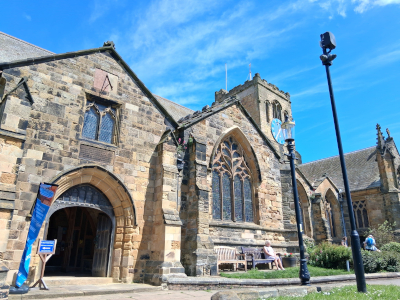
William Tyndale may never have visited Scarborough but St Mary’s Church in Scarborough recently had a great time learning all about him as part of the "Big Ideas by the Sea" festival.
Children from local schools spent time learning about William Tyndale, trying out AI Tyndale and designing and printing their own Bible front cover. They loved all the gruesome parts of the story of his life as well as finding out about printing and smuggling.
Many of the children were able to share stories of their experiences of arriving in school not being able to understand the language of lessons until they learnt English, and how important it is hearing lessons and worship in their own languages.
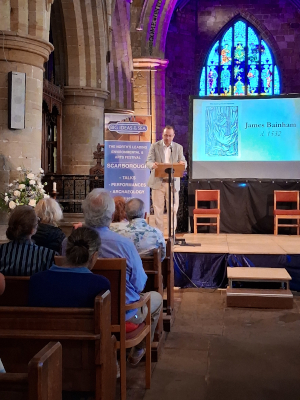
The adults then had their turn. A packed church heard an entertaining and informative talk by Dr Harry Spillane entitled ‘When God spoke English’. Dr Harry was most kind in staying and preaching the following morning – appropriately on Pentecost Sunday.
This was, for the most part, a forgotten part of church history for the folks here in Scarborough until prompted by church members to find out more. A big thank you to the Tyndale Society for all the help they gave us with this, as well as Dr Harry Spillane for making his way to the wilds of North Yorkshire to speak to us.
The Tyndale exhibition in St Mary’s Church continues until September 2026.
Report by Revd Samantha Treadwell
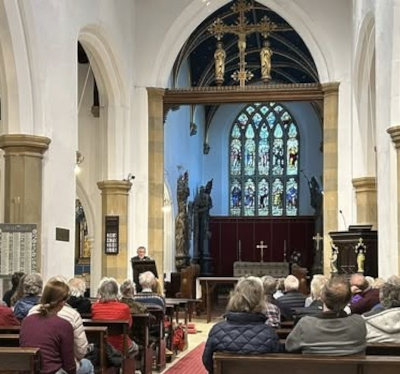
Amersham Museum, St Mary’s Church and the Tyndale Society hosted two talks at Old Amersham Parish Church to mark Tyndale500. With such a strong local history of Lollardy and great community interest, not least through the regular production of the Amersham Martyrs’ Community Play, the anniversary presented a welcome opportunity to hear from experts on the topic.
Neil Rees spoke on 'The Importance and Legacy of Tyndale's Translation' on 5th May, and Andrew Hope’s topic was 'From Wyclif through to Tyndale and beyond: The Reformation in Amersham' on 12th May. The appreciative audiences were able to ask questions of the speakers which ranged from literacy rates in 16th Amersham to how the local political officials might have viewed the Lollards.
Report by Briony Hudson, Amersham Museum

The Tyndale Talk on 8th May 2026 was given by teacher, author and speaker, Dr Harry Spillane.
Harry Spillane is a member of the Tyndale Society and Bye-Fellow in History at Downing College, Cambridge University, England. His fascinating talk was entitled "Prophets and Profit: Printing Tyndale's Works". He explained about the print history of Tyndale's New Testament and early reprints and editions of Bibles through the Tudor period.
The talk was joined by Tyndale Society members from around the world and led to some great questions. His new book telling the story and called "Selling the Word of God - The Early Commercial History of the English Bible" is coming out in September. For further details, follow the link below.

On Tuesday 28th April 2026, St Paul's Cathedral in London hosted a lecture to mark the 500th anniversary of the publication of William Tyndale's New Testament.
The speaker was Diarmaid MacCulloch, who spoke at the 2025 Tyndale Conference in Antwerp. He is a widely respected scholar, speaker, author and broadcaster in religious history. He reflected on the background, history and the impact of William Tyndale and his English translation of the New Testament, to an audience of over eight hundred people, including members of the Tyndale Society.
You can watch a recording of his talk online through YouTube by clicking on the link below.

An exhibition with information about WIlliam Tyndale, prepared by Tyndale Society member Paul Linnell, has been on display at Leicester Cathedral, through November and December 2025. From there it moved to Lutterworth Church in Leicestershire and it will be based at Wellingborough URC in Northamptonshire throughout March and April 2026.
If you would like to arrange for the exhibition to be based in your own church for a period, please contact